Basketball is one of those sports that rewards consistent practice. I have always believed that you do not need a professional court every day to improve your basketball skills. A basketball, a little space, and a good practice routine can help you become a better player even when you are at home.
If you want to know how to practice basketball at home, the most important thing is to focus on the skills that you can safely develop in a limited space. Ball handling, footwork, coordination, passing technique, shooting form, and physical conditioning can all be practiced without visiting a basketball court.
In my experience, practicing for a short time every day is often more useful than doing one long session once a week. The key is consistency and quality.
Why Practice Basketball at Home?
Practicing basketball at home gives you an opportunity to work on your weaknesses without the pressure of a game or team practice. You can repeat the same movement several times until it starts to feel natural.
Home basketball practice can also be useful when the weather is bad, the local court is busy, or you simply do not have enough time to travel somewhere else.
You do not need expensive equipment. A basketball and a safe practice area are enough for many drills. If you have extra space, you can also use cones, water bottles, a jump rope, or other safe household objects as training markers.
The goal should not be to copy everything you would do on a full basketball court. Instead, focus on improving the fundamental skills that will help you when you return to the court.
Start With a Proper Warm Up
Before starting basketball drills at home, I recommend spending a few minutes warming up. This prepares your body for movement and helps you practice with better control.
Start with light jogging in place, arm circles, bodyweight squats, and gentle leg movements. You can also perform high knees for a short period.
A good warm up does not have to be complicated. Five to ten minutes is usually enough for a basic home practice session.
I also like to include some simple basketball movements during warm up. Try moving the ball around your waist, legs, and head. These exercises can help improve coordination and make your hands feel comfortable with the basketball.
Practice Basic Ball Handling
Ball handling is one of the best basketball skills to practice at home because it requires very little space.
Start with simple stationary dribbling. Stand with your knees slightly bent and keep your eyes forward. Dribble the basketball with your right hand for a few seconds, then switch to your left hand.
Once you become comfortable, try low dribbles and then higher controlled dribbles. The purpose is not simply to bounce the ball quickly. You want to develop control.
You can also practice crossover movements. Dribble with your right hand, move the ball across your body, and continue with your left hand. Start slowly and increase your speed as your control improves.
Another useful exercise is the between the legs dribble. This requires more coordination, so beginners should take their time.
Improve Your Weak Hand
One of the biggest mistakes I see beginners make is practicing mostly with their dominant hand. If you want to become a more complete basketball player, your weak hand needs regular attention.
Spend part of every practice session using only your weaker hand. Start with basic stationary dribbling. When that becomes comfortable, add low dribbles, direction changes, and controlled crossovers.
At first, your weak hand may feel uncomfortable. That is completely normal. The more often you use it, the more natural the movement will become.
I would rather spend ten focused minutes improving my weak hand than spend the entire session doing something that already feels easy.
Practice Footwork at Home
Good footwork can make a major difference in basketball. You can practice many footwork movements without a hoop or even a basketball.
Start with your basic athletic stance. Keep your feet around shoulder width apart, bend your knees, and keep your body balanced.
Practice moving forward, backward, and from side to side. Work on stopping under control instead of allowing your body to carry you forward.
You can also practice pivoting. Imagine receiving a basketball from a teammate. Establish your pivot foot and practice turning your body while keeping that foot in place.
Another useful drill is the jump stop. Take a few controlled steps and land with both feet together. Focus on balance and body control.
These simple movements can help you feel more comfortable when playing against real opponents.
Work on Shooting Form
Shooting is another important basketball skill, but practicing full shots at home is not always practical. You may not have enough ceiling height or a suitable hoop.
Instead, you can practice shooting mechanics without actually shooting the ball.
Hold the basketball in your normal shooting position. Focus on your hand placement, elbow position, and wrist movement. Slowly extend your shooting arm and finish with your fingers pointing toward the target.
You can perform form shooting into a safe target if you have a suitable indoor hoop. However, always make sure the area is safe and that nothing valuable can be damaged.
Another useful option is to practice your shooting motion while sitting down. This reduces the involvement of your legs and allows you to focus more closely on your hand and wrist mechanics.
Practice Passing Skills
Passing may be difficult without another person, but you can still work on your passing technique at home.
If you have a safe wall and permission to use it, practice chest passes against the wall. Stand a comfortable distance away and pass the basketball toward a specific target.
Focus on keeping both hands involved and finishing the pass with your fingers pointing toward the target.
You can also practice bounce passes. Aim for a point on the floor so the ball returns to you at a comfortable height.
If you cannot use a wall, practice the passing motion without releasing the ball. It may seem simple, but repeating the correct movement can help you understand the mechanics.
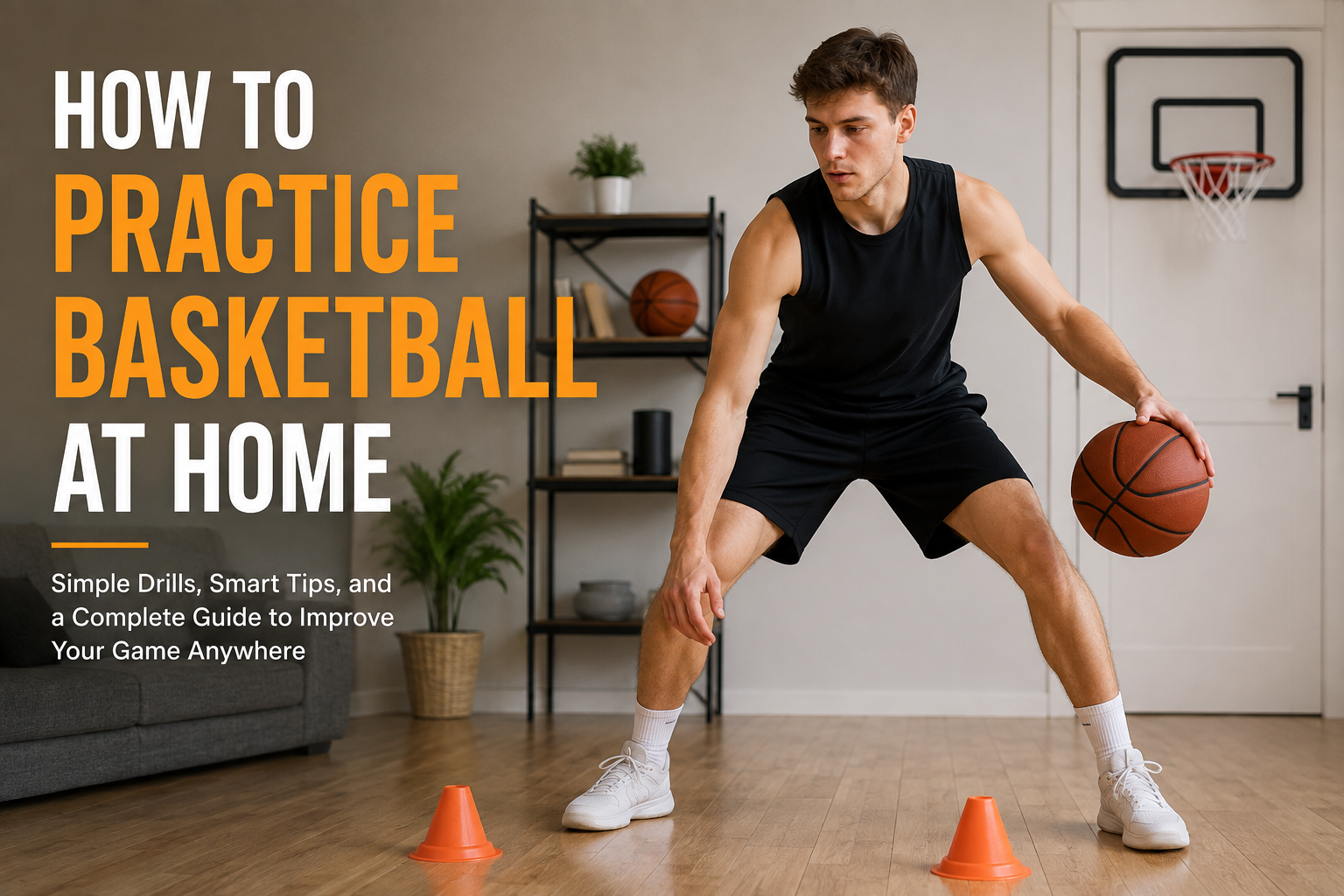
Use Cone Dribbling Drills
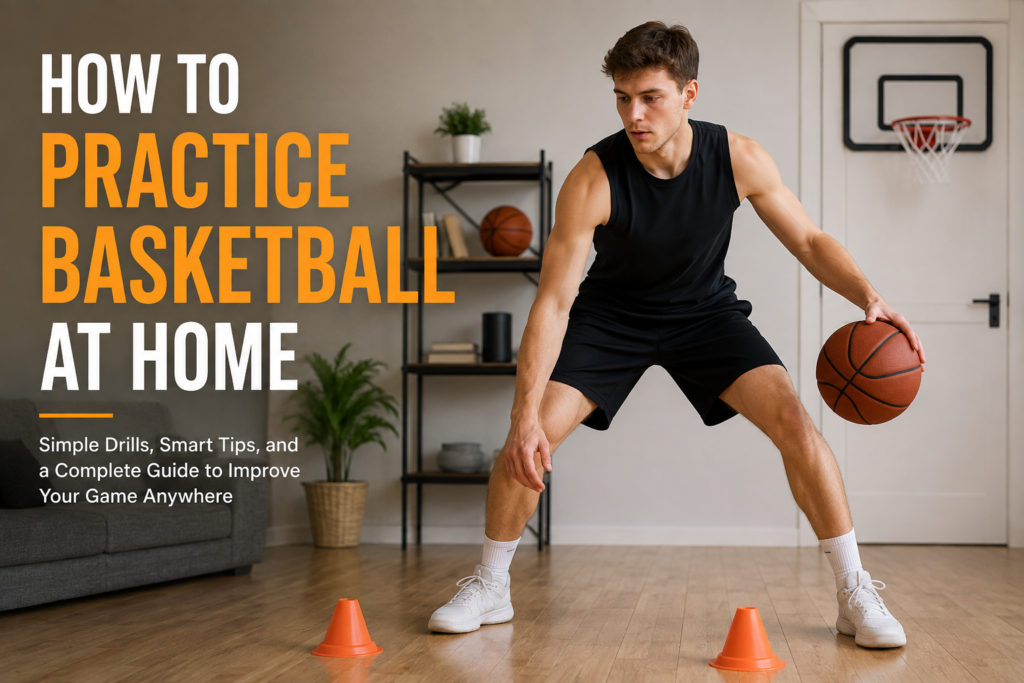
If you have a little floor space, set up several cones or safe markers. Water bottles can also work if they are stable and cannot easily break.
Place the markers several steps apart and dribble around them. Use your right hand going one direction and your left hand coming back.
As your skills improve, add crossovers around each marker. You can also practice changing your speed.
The most important thing is control. Do not rush through the drill simply because speed looks impressive. Good basketball dribbling requires the ability to change direction while maintaining control.
Improve Your Coordination
Basketball requires your eyes, hands, feet, and brain to work together. You can improve coordination with simple exercises.
Try moving the basketball around your waist while standing still. Then move it around each leg. You can combine these movements into a continuous routine.
Another exercise is switching the ball between your hands while keeping your eyes forward. This encourages you to rely on your sense of touch instead of constantly watching the ball.
Over time, these exercises can make ball handling feel more natural.
Add Basketball Conditioning
Skill practice is important, but basketball also requires fitness. You can add simple conditioning exercises to your home routine.
Bodyweight squats can help strengthen your legs. Lunges can improve lower body control. Calf raises can work the lower legs, while planks can strengthen your core.
Jump rope is another useful option if you have enough space and a safe surface.
I recommend keeping conditioning simple. You do not need to exhaust yourself during every session. The goal is to become stronger and more athletic while still having enough energy to practice basketball skills.
Create a Simple Home Basketball Routine
Having a routine makes home basketball practice easier. Instead of deciding what to do every day, prepare a simple schedule.
For example, you could spend ten minutes warming up, fifteen minutes on ball handling, ten minutes on weak hand drills, ten minutes on footwork, and ten minutes on shooting mechanics or passing.
If you have a hoop, you can finish with shooting practice.
You can adjust the routine according to your available space and skill level. Beginners should focus heavily on fundamentals, while more experienced players can increase the difficulty of their drills.
Track Your Progress
One thing I strongly recommend is keeping track of your progress. It is easy to practice regularly without realizing how much you have improved.
Write down how long you practiced, which drills you completed, and what felt difficult.
You can also record yourself performing certain drills. Watching your movement can help you notice mistakes that you may not feel while practicing.
Try to measure progress in realistic ways. Maybe you can complete more controlled dribbles with your weak hand, perform faster crossovers, or maintain better balance during footwork drills.
Small improvements add up.
Stay Consistent
The biggest secret to improving basketball skills at home is consistency.
You do not need to practice for several hours every day. Even twenty to thirty minutes of focused practice can be valuable when you do it regularly.
I believe it is better to practice a few important skills correctly than to rush through dozens of drills without paying attention.
Try to make basketball practice part of your normal routine. Choose a time when you are usually free and make that your practice period.
Final Thoughts
Learning how to practice basketball at home is mainly about using your available space intelligently. You may not have a full court, but you can still improve ball handling, footwork, coordination, passing technique, shooting form, and physical conditioning.
From my point of view, the most important thing is to focus on fundamentals and repeat them consistently. Do not worry if your first few sessions feel difficult. Basketball skills develop through repetition.
Start with simple drills, practice your weak hand, improve your footwork, work on your shooting mechanics, and gradually increase the difficulty.
With patience and regular practice, your home can become a useful place to develop your basketball skills. When you eventually step onto a real court, the movements you practiced at home can help you feel more confident, controlled, and prepared.