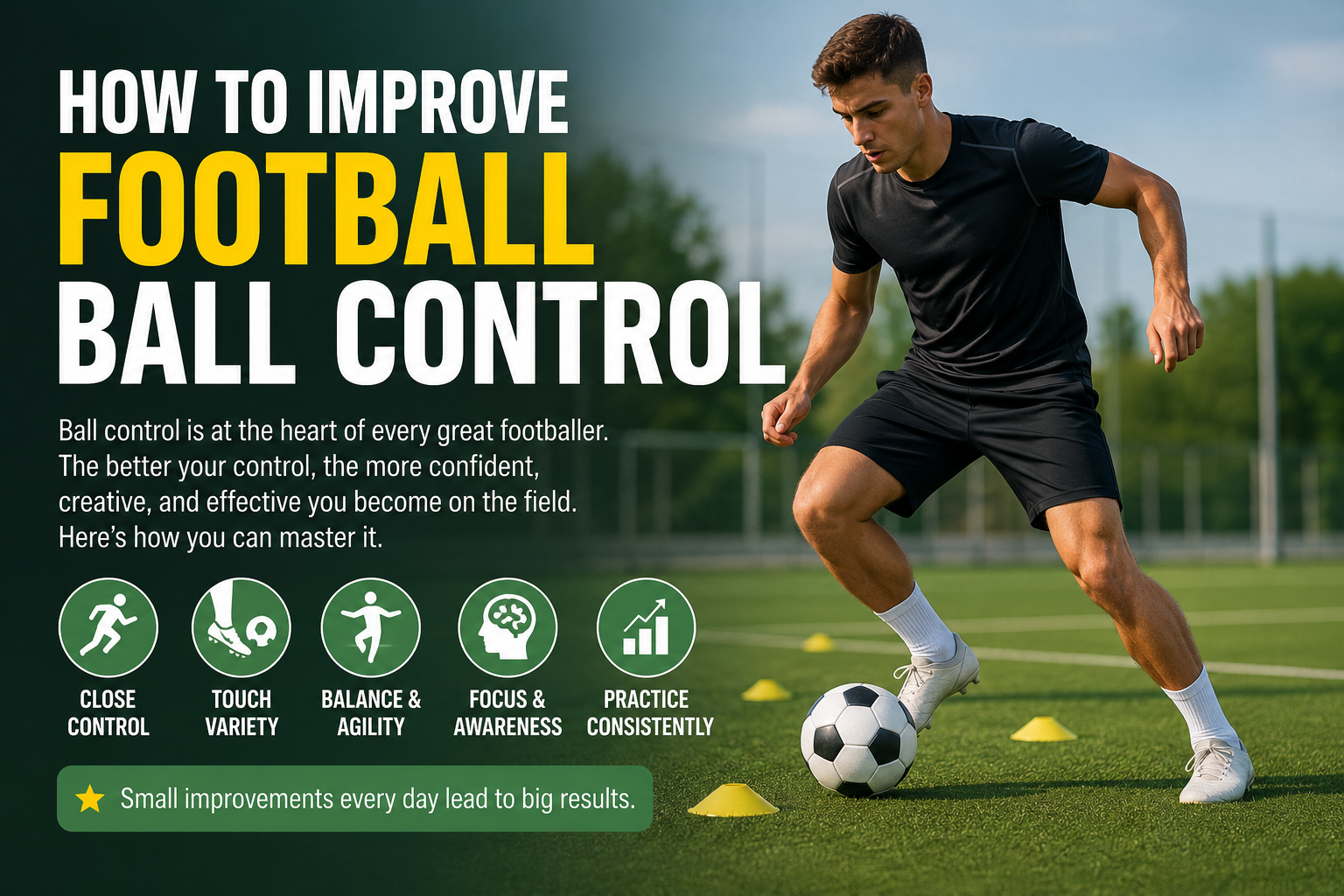
Football ball control is one of the most important skills a player can develop. In my opinion, a player who can control the ball comfortably has a big advantage because good control gives you more time, more confidence, and more options during a match. You do not need to be a professional footballer to improve your touch. With regular practice and the right football drills, anyone can develop better ball control.
When I think about ball control, I do not only mean keeping the ball close to your feet. Good ball control means receiving the ball properly, changing direction quickly, protecting possession, and preparing your next move with your first touch. These skills can make a noticeable difference whether you play football casually, for a school team, or at a competitive level.
What Is Football Ball Control?
Football ball control is the ability to receive, keep, move, and manipulate the ball effectively. It involves different parts of your feet, including the inside, outside, sole, and instep. Your thighs, chest, and other parts of the body can also be used when controlling passes from different heights.
A player with good ball control does not panic when the ball arrives quickly. Instead, the player knows how to soften the touch and move the ball into a useful position. This is something I believe every football player should work on because it directly affects passing, dribbling, shooting, and decision making.
Focus on Your First Touch
If you want to improve football ball control, start with your first touch. Your first touch determines what happens next. A poor touch can put the ball too far away, while a good touch can give you enough space to pass, dribble, or shoot.
When receiving a pass, try not to simply stop the ball underneath your foot. Instead, guide the ball into the space where you want to move next. For example, if you receive the ball from your right side and want to move forward, your first touch should ideally take the ball slightly forward.
Practice receiving the ball with the inside of both feet. Once you become comfortable, use the outside of your feet and the sole as well.
Practice With Both Feet
One common mistake I see among developing players is relying too much on their stronger foot. Your stronger foot may feel more comfortable, but football becomes much easier when both feet can control the ball.
Start with simple exercises. Pass the ball against a wall using your right foot and control the return with your left foot. Then reverse the exercise. You can also pass with one foot and receive with the other.
Do not worry if your weaker foot feels awkward at first. That is normal. The goal is to gradually make it more natural. Even ten or fifteen minutes of weaker foot practice several times a week can help improve your overall ball control.
Use a Wall for Ball Control Practice
A wall can become one of your best training partners. You do not need expensive equipment or a large football ground. All you need is a safe wall, a football, and enough space.
Stand a few meters away from the wall and pass the ball against it. When the ball comes back, control it and pass again. Start slowly and concentrate on the quality of your first touch.
As your confidence improves, increase the speed. Try controlling the ball with different parts of your feet. You can also take one touch before passing and eventually challenge yourself to play quicker.
This simple football ball control drill can improve your touch, reaction time, passing accuracy, and coordination at the same time.
Improve Close Control
Close control becomes especially important when you are surrounded by opponents. When the ball stays close to your feet, you can change direction more easily and protect possession.
Try moving the ball gently between your feet while standing in one place. Then move forward slowly while touching the ball with your left and right feet. Once you feel comfortable, increase your speed.
Another useful exercise is cone dribbling. Place several cones a short distance apart and move the ball around them using small touches. Focus on keeping the ball close rather than simply completing the course quickly.
In my view, quality is more important than speed during the early stages of training. Once your technique becomes natural, speed will come with practice.
Learn to Control the Ball With Different Surfaces
A football can arrive at different heights and angles during a match. That is why players should learn to control the ball with more than just the inside of the foot.
Practice using the inside of your foot for normal passes. Use the outside when you need to change direction quickly. Use the sole when the situation allows you to stop or move the ball backward.
You can also practice controlling bouncing balls with your thigh and chest. Start with gentle passes and gradually make them more challenging.
The more surfaces you can use comfortably, the more prepared you will be during a real match.
Keep Your Body Relaxed
Your body position has a major effect on ball control. If you are too stiff, your touch can become heavy. Try to stay relaxed while keeping your knees slightly bent.
Keep your eyes on the ball when necessary, but also develop the habit of looking around before receiving it. This is important because good ball control is not only about touching the ball. It is also about knowing what you want to do before the ball reaches you.
When possible, check your surroundings before receiving a pass. This allows you to understand where your teammates and opponents are positioned.
Practice Ball Control at Different Speeds
Many players practice their skills slowly but struggle when the game becomes fast. To improve your football ball control, you should eventually practice at different speeds.
Begin with controlled movements. Then increase the pace while maintaining good technique. Try receiving a pass, taking your first touch into space, and accelerating for a few steps.
You can also combine ball control with changes of direction. Dribble toward a cone, take a touch to the side, accelerate past it, and then repeat the movement.
This type of training helps you develop control that is more useful in real match situations.
Work on Your Coordination and Balance
Good football ball control requires coordination between your eyes, feet, legs, and body. Balance is also important because football often requires you to control the ball while moving or turning.
Simple exercises such as single leg balance, quick foot movements, and controlled dribbling can help. You can also practice juggling the ball with your feet and thighs.
Do not become frustrated if you cannot juggle many times at first. Juggling is a skill that improves gradually. Start by keeping the ball in the air for a few touches and try to increase your record over time.
Try Juggling Every Day
Juggling is one of my favorite individual exercises for improving touch. It teaches you how the ball reacts to different parts of your foot and helps develop coordination.
Start by dropping the ball onto your foot and catching it after one touch. Then try two touches before catching it. Continue building from there.
Once you become comfortable, alternate between your left foot, right foot, and thighs. Eventually, challenge yourself to keep the ball in the air without catching it.
Even a short juggling session can be useful when included regularly in your training routine.
Practice Under Pressure
Ball control during a quiet training session is different from ball control during a match. In a game, opponents are trying to take the ball away from you.
To prepare for this, practice with a teammate. Ask your teammate to apply light pressure while you receive and protect the ball. Work on turning away from pressure and using your body to keep the opponent away from the ball.
You can also play small sided games. These games give you more opportunities to receive passes, make quick decisions, and control the ball in crowded areas.
Do Not Forget Your Head
Football is a mental game as much as a physical game. Confidence can affect your touch. If you become nervous every time the ball comes toward you, you may rush your movement.
Try to stay calm and trust your training. Mistakes are part of learning. If you lose control of the ball during practice, think about what went wrong and try again.
I believe consistent practice is more valuable than trying to become perfect in one session.
Create a Simple Ball Control Routine
You do not need to train for hours every day. A short and focused routine can be enough if you practice consistently.
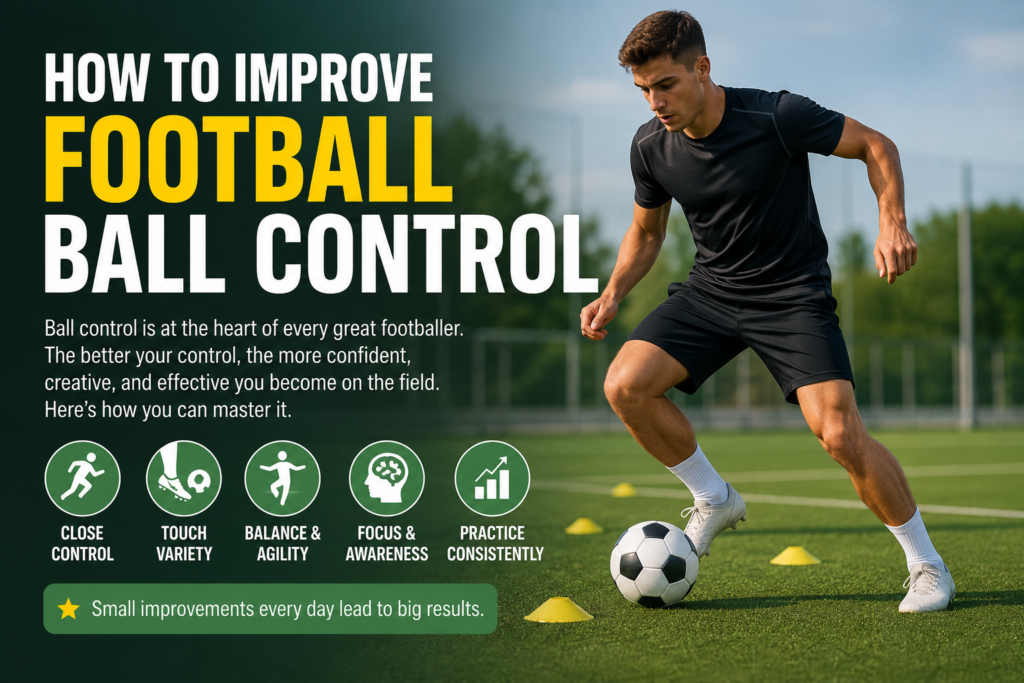
For example, you can spend five minutes juggling, ten minutes passing against a wall, ten minutes working on close control, and ten minutes dribbling around cones.
As you improve, increase the difficulty rather than simply increasing the training time. Use your weaker foot, increase your speed, reduce the space between cones, and practice receiving the ball from different angles.
Common Ball Control Mistakes
One mistake is always looking down at the ball. You need to watch the ball during certain moments, but football requires awareness of your surroundings too.
Another mistake is taking heavy touches. Try to make controlled touches that keep the ball within your playing distance.
Some players also focus too much on complicated skills. Fancy moves can be useful, but basic control should come first. If your first touch and close control are strong, advanced skills become easier to learn.
Finally, avoid practicing only with your dominant foot. Developing both feet can make you a much more complete player.
Final Thoughts
Improving football ball control takes time, but the process can be enjoyable. In my opinion, the most important thing is consistency. You do not need a professional training facility to improve. A football, a wall, a few cones, and a small amount of space can provide plenty of opportunities to practice.
Focus on your first touch, train both feet, practice close control, improve your coordination, and gradually introduce pressure and speed. Try to practice regularly rather than doing one long session and then stopping for several days.
The better your football ball control becomes, the more confident you can feel with the ball. Good control can improve your passing, dribbling, movement, and overall performance. Start with simple drills, stay patient, and keep challenging yourself. Small improvements made consistently can eventually become a major difference on the football field.