
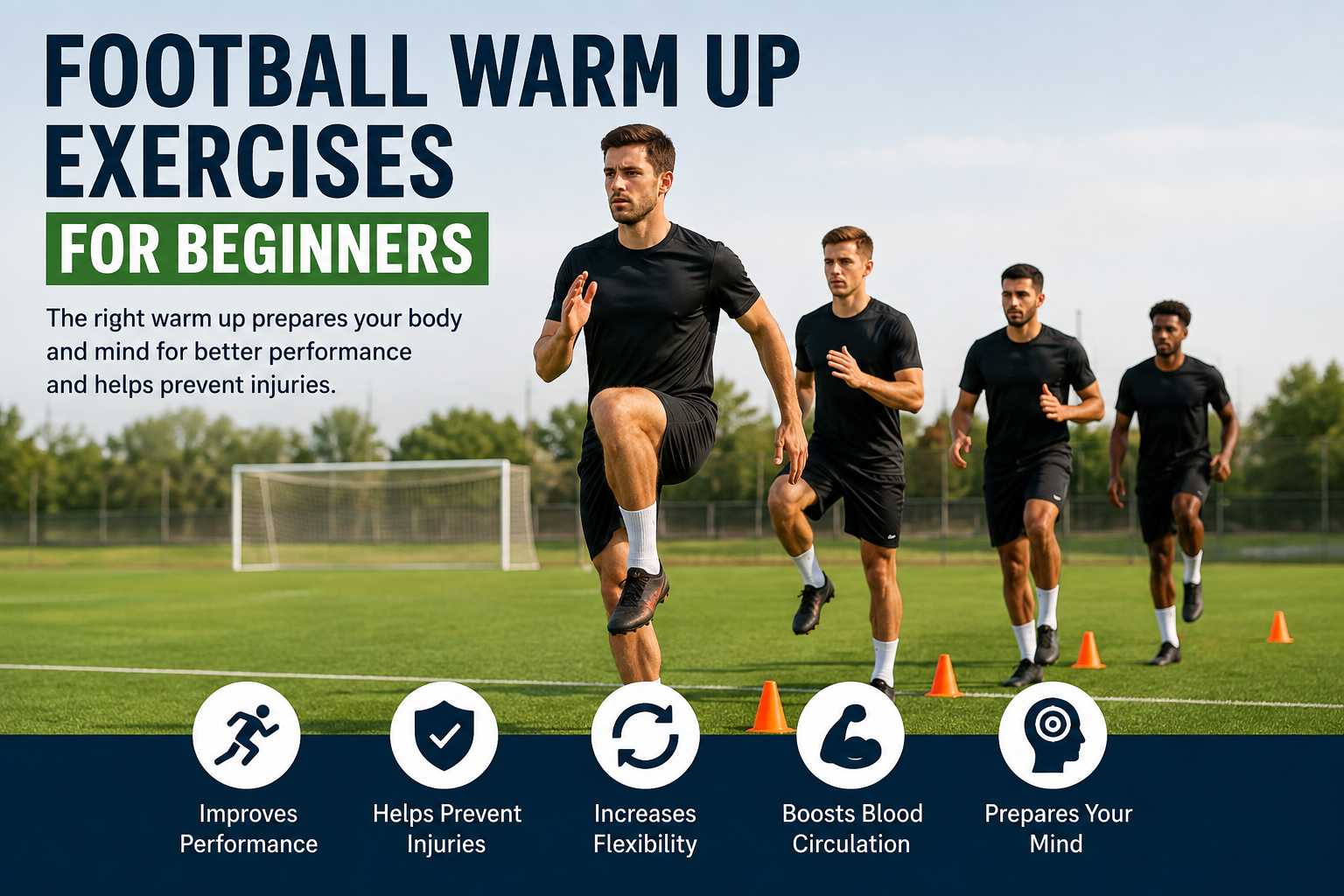
When I started learning football, I quickly realized that warming up was not something I should ignore. Many beginners want to get straight into passing, shooting, dribbling, or playing a match, but the body needs time to prepare for these movements. A good football warm up helps increase body temperature, improve movement, prepare the muscles, and get the mind ready for the session.
In my opinion, football warm up exercises for beginners do not need to be complicated. You can build an effective routine with simple movements that take around 10 to 15 minutes. The important thing is to perform each exercise correctly and gradually increase the intensity.
In this article, I will share some of the best football warm up exercises for beginners and explain how I use them to prepare for football training or a game.
Why Is a Football Warm Up Important?
A proper warm up prepares your body for physical activity. Football involves running, stopping, turning, jumping, kicking, and changing direction quickly. If your body goes from complete rest directly into these movements, you may not feel comfortable or prepared.
I believe a good warm up also improves concentration. When I warm up properly, I feel more focused and ready to react to the ball and other players.
A football warm up can help increase circulation, loosen the muscles, improve movement, and prepare your joints for activity. It can also help you gradually move from a relaxed state into the intensity required during football.
How Long Should a Football Warm Up Take?
For beginners, I recommend spending around 10 to 15 minutes warming up before football training or a match. You do not need to spend half an hour doing difficult exercises.
The first few minutes should involve light movement. After that, you can add dynamic exercises, mobility movements, and football specific activities.
The goal is to gradually increase your intensity rather than becoming tired before the actual training session begins.
1. Light Jogging
Light jogging is one of the simplest football warm up exercises for beginners. I usually start with a gentle jog for a few minutes.
Jogging increases your body temperature and gets your legs moving. Keep the pace comfortable at first. There is no need to sprint immediately.
You can jog around the football field, between cones, or over a small area. As your body starts feeling warmer, gradually increase your pace.
For beginners, around two to three minutes of light jogging is usually a good starting point.
2. High Knees
High knees are useful for getting your legs ready for running and quick movements. Start by jogging slowly while lifting each knee toward your waist.
Keep your upper body controlled and move your arms naturally. You do not need to lift your knees extremely high.
I like using high knees for about 20 to 30 seconds before moving to another exercise. If you are new to football training, start slowly and focus on good technique.
3. Butt Kicks
Butt kicks are another simple dynamic warm up exercise. While jogging forward, bring your heels toward your hips.
This movement gets the legs active and introduces a different running pattern. I find it useful after light jogging because it keeps the warm up interesting while preparing the lower body.
Perform butt kicks for about 20 to 30 seconds. Keep your movement controlled instead of trying to move as fast as possible.
4. Leg Swings
Football requires flexible and mobile legs, especially when passing, shooting, and changing direction. Leg swings are an easy way to prepare the hips and legs.
Stand beside a stable object if you need support. Swing one leg gently forward and backward. Keep the movement controlled and avoid forcing your leg too high.
After several repetitions, switch legs.
You can also perform side to side leg swings to prepare different muscles around the hips. The main purpose is to create comfortable movement rather than stretching as far as possible.
5. Walking Lunges
Walking lunges are a useful exercise for preparing the legs and hips. Take a controlled step forward and lower your body into a lunge position. Push through the front foot and bring the other leg forward.
Keep your upper body upright and avoid rushing the movement.
For beginners, I recommend starting with around 8 to 10 lunges on each side. If you have never performed lunges before, practice the movement slowly before using it as part of your football warm up.
6. Side Shuffles
Football players rarely move only forward. You often need to move sideways when defending, creating space, or following another player.
Side shuffles help prepare you for these movements. Bend your knees slightly and move sideways using small controlled steps.
Try shuffling for around 20 to 30 seconds in one direction and then return to your starting position.
As you become more comfortable, you can increase the speed while maintaining control.
7. Arm Circles
A football warm up should not focus only on the legs. Your upper body also plays an important role in balance and movement.
Arm circles are very simple. Extend your arms and make small circles. Gradually make the circles larger, then change direction.
I usually include this exercise for around 20 seconds. It is especially useful after jogging because it helps bring movement into the upper body as well.
8. Dynamic Calf Raises
Your calves work hard when you run, accelerate, jump, and change direction. Calf raises are an easy way to prepare them.
Stand upright and slowly rise onto your toes. Lower your heels back down with control.
You can perform around 10 to 15 repetitions. Do not rush through them. The goal is to prepare your muscles, not exhaust them.
9. Dynamic Hamstring Movement
The hamstrings are heavily involved in running and football movements. Instead of holding a long static stretch before training, beginners can use gentle dynamic movements.
One simple option is to walk forward while extending one leg slightly in front of you and keeping the movement controlled. You can gradually increase the range of movement as you become more comfortable.
The important thing is to avoid forcing the stretch.
10. Short Accelerations
After completing the easier exercises, I like to finish the warm up with a few short accelerations.
Start with a gentle jog and gradually increase your speed over a short distance. You do not need to sprint at maximum speed.
Perform two or three controlled accelerations and allow yourself to recover between them.
This helps your body transition from a general warm up into the faster movements that are common during football.
11. Ball Touches
Once your body is warm, adding the football to your routine is a great idea. Beginners can perform simple ball touches using both feet.
Try passing the ball between your feet with short touches. You can also gently dribble around cones or another safe area.
Ball touches help prepare your feet and improve your connection with the football. They also help you become mentally focused on the session.
12. Easy Passing
Simple passing is another excellent football warm up activity. If you have a partner, stand a short distance apart and pass the ball gently.
Focus on accuracy rather than power. Use the inside of your foot and control the ball when it comes back.
You can gradually increase the passing speed as your body becomes warmer.
A Simple 10 Minute Football Warm Up Routine
If you are a beginner and want something easy to follow, I would suggest this routine:
Two minutes of light jogging
Thirty seconds of high knees
Thirty seconds of butt kicks
One minute of leg swings
One minute of walking lunges
One minute of side shuffles
Thirty seconds of arm circles
One minute of calf raises and dynamic leg movements
Two minutes of ball touches and easy passing
This routine is simple enough for beginners but still covers several important movement patterns.
Common Warm Up Mistakes Beginners Should Avoid
One mistake I see often is starting too intensely. A warm up should prepare you for football, not make you tired before the session starts.
Another mistake is skipping the upper body. Football involves your entire body, so your arms, shoulders, hips, and core should also be involved in your preparation.
Some beginners also rush through exercises without paying attention to technique. I believe controlled movement is more valuable than speed during the early part of a warm up.
It is also important to listen to your body. If an exercise causes sharp or unusual pain, stop and avoid pushing through it.
Dynamic Warm Up vs Static Stretching
For a football warm up, I prefer dynamic movements because they allow you to move your body through different ranges of motion while gradually increasing intensity.
Examples include jogging, leg swings, lunges, high knees, side shuffles, and controlled accelerations.
Long static stretches are generally better suited to other parts of a training routine rather than being the main activity immediately before intense football movements.
The goal before football is to feel warm, mobile, alert, and ready to move.
How Beginners Can Improve Their Warm Up
The best football warm up routine is one that you can perform consistently. You do not need to change your exercises every day.
Start with basic movements and learn how your body responds. After a few weeks, you can add more football specific movements such as quick changes of direction, controlled dribbling, short passes, and gentle accelerations.
I also recommend preparing before you reach the field. Make sure you have suitable football shoes, comfortable clothing, water, and enough space to move safely.
Final Thoughts
Football warm up exercises for beginners are an important part of preparing for training and matches. A few simple exercises can help your body gradually move from rest to activity while also improving your focus.
In my experience, the best approach is to keep the warm up simple. Start with light jogging, add dynamic movements such as high knees and leg swings, include side shuffles and lunges, and finish with football specific activities such as ball touches and easy passing.
You do not need an advanced routine to get started. What matters most is consistency, proper technique, and gradually increasing the intensity.
If you make a football warm up part of every training session, you can enter the field feeling more prepared and confident. For beginners, that simple habit can make football training feel more comfortable and enjoyable while helping you build better movement habits over time.
Note: This article provides general fitness information and is not a substitute for advice from a qualified sports professional or healthcare provider, especially if you have an existing injury or medical concern.