
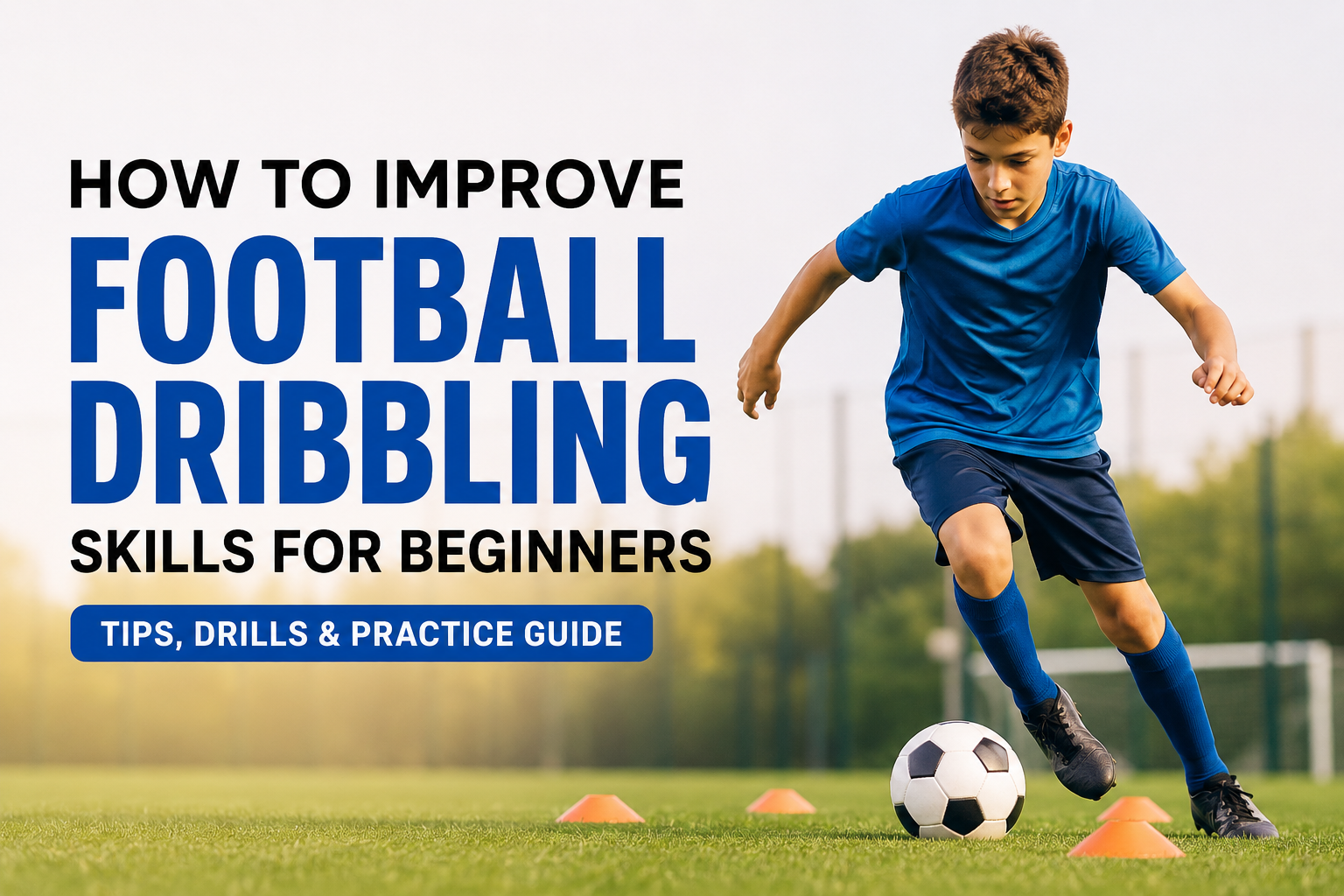
Football dribbling is one of the most useful skills a beginner can develop. Good dribbling allows you to control the ball, move past defenders, create space, and keep possession when you are under pressure. In my opinion, dribbling is not about performing complicated tricks all the time. It is mainly about having close control, confidence, balance, and the ability to change direction quickly.
When I first think about improving football dribbling skills, I focus on simple movements before trying advanced techniques. A beginner who can control the ball with both feet and change direction comfortably already has a strong foundation. The good news is that you do not need expensive equipment or a professional football field to practice. With a football, a few cones, and regular practice, you can make noticeable progress.
What Is Football Dribbling?
Football dribbling means moving with the ball while keeping it under control. A player uses different parts of the foot to guide the ball while looking for space or trying to move away from an opponent.
Dribbling can be slow when you are controlling the ball in a crowded area, or fast when you have open space in front of you. The important thing is to keep the ball close enough to control while still being able to move naturally.
For beginners, the main goal should be improving ball control rather than learning a large number of tricks.
Start With Basic Ball Control
Before learning advanced football dribbling techniques, I recommend spending time on basic ball control. If your first touch is poor, complicated dribbling moves will be much harder to perform.
Start by gently moving the ball from one foot to the other. Use the inside of your foot to push the ball across your body. Then use the outside of your foot to move it back.
Try to keep your touches light. A common beginner mistake is kicking the ball too far away. When the ball stays close to your feet, you have more control and can react quickly.
Practice this movement for several minutes every day. As your confidence improves, increase the speed without losing control.
Learn to Use Both Feet
One of the best ways to improve football dribbling skills for beginners is to train both feet. Many new players naturally depend on their stronger foot. This can make their movement predictable.
Try spending equal time practicing with your left and right foot. You do not need to become equally skilled with both feet immediately. The goal is simply to become comfortable using either foot.
For example, dribble forward using your right foot for one minute. Then repeat the exercise with your left foot. After that, practice changing direction using both feet.
Using both feet gives you more options during a match. If a defender blocks one side, you can use the other foot to move into space.
Practice Close Control
Close control is the foundation of effective dribbling. When the ball is close to your feet, you can make quick decisions and respond to defenders.
Place several cones in a straight line with enough space between them. Slowly dribble through the cones while touching the ball with the inside and outside of your feet.
Do not worry about speed at the beginning. Focus on keeping the ball close. Once the movement becomes comfortable, gradually increase your pace.
I believe this type of practice is more useful for beginners than simply trying to dribble as fast as possible. Control should come first. Speed can be added later.
Improve Your Change of Direction
Being able to change direction quickly is an important part of football dribbling. A defender may expect you to continue moving forward, so changing direction at the right moment can help you create space.
You can practice this with a simple cone drill. Place two cones several meters apart. Dribble toward one cone, turn around it, and move toward the other cone.
Use the inside of your foot for one turn and the outside of your foot for another. You can also practice stopping the ball with the sole of your foot before moving in another direction.
As you become comfortable, try to make your turns quicker while keeping the ball close.
Use Simple Dribbling Moves
Beginners do not need dozens of football skills and tricks. A few simple moves can be extremely effective when practiced properly.
The body feint is a good example. Move your body slightly in one direction while keeping the ball under control, then quickly move in the opposite direction.
The step over is another useful skill. Move your foot around the front of the ball as if you are going one way, then take the ball in the opposite direction.
The inside and outside touch is also simple and practical. Use the inside of your foot to move the ball one way and the outside to move it back.
The key is repetition. A move that you can perform naturally is more useful than a complicated trick that you cannot control during a match.
Keep Your Head Up
Many beginners look at the football constantly while dribbling. Looking at the ball is normal when learning, but you should gradually learn to look up.
Try taking short glances at the ball while also looking at what is happening around you. This helps you identify teammates, opponents, and open spaces.
One simple exercise is to dribble around an open area while regularly looking forward. You can also ask a friend to stand nearby and point in different directions. Try to notice the direction while continuing to control the ball.
This skill takes time, but it can make your dribbling much more useful during real matches.
Practice Changing Speed
Good dribbling is not always about moving quickly. Sometimes the best way to beat a defender is to slow down and then accelerate suddenly.
Practice walking slowly with the ball for a few seconds. Then increase your speed for several meters. After that, slow down again.
This teaches your body to control different speeds. When you combine a change of direction with a change of speed, your movement becomes harder for defenders to predict.
I recommend adding this exercise to regular football practice because it feels more realistic than simply running through cones at the same speed.
Try Cone Dribbling Drills
Cone drills are one of the easiest ways to practice football dribbling at home or on a small field.
You can place five or six cones in a line and dribble between them. Start slowly and focus on control. Then repeat the drill while increasing your speed.
Another option is to create a small square with four cones. Dribble around the outside of the square and change direction at each corner.
You can also create random cone positions and try to move through them naturally. This can help you develop better reactions because the movement is less predictable.
If you do not have football cones, you can use safe objects that are easy to see and will not cause injury if you accidentally step on them.
Practice With a Partner
Solo practice is useful, but practicing with another person can make your football dribbling training more realistic.
Ask a friend to act as a passive defender. Start by dribbling toward the defender and practice changing direction before reaching them. As you become more confident, allow the defender to apply light pressure.
The purpose is not to win every attempt. The purpose is to learn how to protect the ball and make decisions under pressure.
This type of practice can help you understand when to dribble, when to change direction, and when it is better to pass.
Protect the Ball From Defenders
Ball protection is an important part of dribbling. When a defender is close, you should use your body to keep them away from the ball.
Try placing your body between the defender and the football. Keep the ball on the side that is farther away from the defender whenever possible.
Use your arms naturally for balance without pushing the opponent. Keep your body relaxed and stay ready to turn away if the defender tries to challenge you.
Learning to protect the ball can give beginners more confidence during matches.
Improve Your Balance and Footwork
Good balance makes dribbling easier. Simple footwork exercises can help you become more comfortable with quick movements.
Practice moving sideways, stepping forward and backward, and changing direction. You can also perform simple ladder style footwork exercises if you have access to a training ladder.
You do not need to spend a long time on these exercises. Even five to ten minutes of focused footwork practice can be useful when combined with ball control training.
Create a Simple Practice Routine
Consistency is more important than practicing for hours once a week. I would rather practice football dribbling for twenty to thirty minutes several times a week than train for several hours only occasionally.
A simple beginner routine could start with five minutes of basic ball touches. Spend the next five minutes practicing both feet. Then spend ten minutes on cone dribbling and change of direction exercises.
Finish with five to ten minutes of speed changes and simple dribbling moves.
As your skills improve, you can make the exercises more difficult by increasing your speed, reducing the space, or adding a passive defender.
Common Dribbling Mistakes Beginners Should Avoid
One common mistake is trying to learn too many tricks at once. It is better to master a few basic movements before moving to advanced skills.
Another mistake is touching the ball too far away. Keep your touches controlled, especially when you are near defenders.
Some beginners also focus too much on speed. Fast dribbling is useful, but losing the ball because you cannot control your touches does not help.
Ignoring the weaker foot is another problem. Try to use both feet during every training session.
Finally, do not become frustrated when progress feels slow. Football dribbling takes repetition. Small improvements become noticeable when you practice consistently.
Final Thoughts
Improving football dribbling skills for beginners is mainly about developing control, confidence, balance, and quick decision making. You do not need complicated equipment or advanced tricks to get started.
Focus on close ball control, use both feet, practice changing direction, work on speed changes, and gradually introduce simple dribbling moves. Cone drills and partner exercises can make your training more challenging as you improve.
From my point of view, the most important thing is to enjoy the process and practice regularly. Do not worry about becoming perfect in a few days. Every controlled touch brings you one step closer to becoming a better football player.
If you stay patient and make dribbling part of your regular football training routine, you can build stronger ball control and become more confident when facing defenders on the field.