When I started thinking about home training, I realized that you do not need a full gym or expensive machines to stay active. The right sports equipment can make home workouts more effective, enjoyable, and easier to follow consistently. In my experience, the best home training equipment is not necessarily the most expensive equipment. It is the equipment that matches your fitness goals, available space, and training style.
Whether you want to improve strength, flexibility, endurance, balance, or general fitness, there are several useful pieces of sports equipment that can help you train at home. The good thing is that most of them are simple to use and do not require a large workout area.
Why Home Training Equipment Is Useful
Home training gives you flexibility. You can exercise early in the morning, after work, or whenever you have free time. You also save the time and money that you would normally spend traveling to a gym.
However, having the right equipment can make a big difference. Bodyweight exercises are excellent, but adding resistance, stability, or cardio equipment can give your workouts more variety.
I personally believe that beginners should start with a few basic items instead of buying everything at once. Once you understand what type of training you enjoy, you can add more equipment according to your needs.
1. Exercise Mat
An exercise mat is one of the first pieces of sports equipment I would recommend for home training. It provides a comfortable surface for exercises such as push ups, planks, sit ups, stretching, yoga, and mobility exercises.
A good mat can also provide extra grip and reduce pressure on your knees, elbows, and back. If you train on a hard floor, an exercise mat can make your workout much more comfortable.
Look for a mat that is thick enough for your type of training but still easy to roll and store.
2. Dumbbells
Dumbbells are among the most versatile pieces of home workout equipment. You can use them for exercises that target almost every major muscle group.
Dumbbell squats can train your legs, while shoulder presses can strengthen your shoulders. You can also perform rows, lunges, curls, chest presses, and many other exercises.
For beginners, a lighter pair of dumbbells can be enough to learn proper technique. As your strength improves, you can gradually increase the resistance.
If storage space is limited, adjustable dumbbells can be a practical option because one set can provide several resistance levels.
3. Resistance Bands
Resistance bands are another excellent choice for home workouts. They are lightweight, affordable, and easy to store.
I especially like resistance bands because they can be used for strength training, warmups, mobility work, and rehabilitation exercises. You can use them for rows, squats, glute exercises, shoulder movements, and many other exercises.
Different bands provide different levels of resistance. Beginners can start with lighter bands and gradually move to stronger ones.
They are also useful for people who travel because they take very little space in a bag.
4. Jump Rope
If you want to improve cardiovascular fitness at home, a jump rope can be extremely useful. Jumping rope increases your heart rate and can be a simple way to add cardio to your training routine.
You do not need a treadmill or large machine. A small open area may be enough, although you should make sure there is enough space above your head and around your body.
Beginners can start with short intervals. For example, you can jump for 20 to 30 seconds and then rest before repeating the exercise.
With regular practice, you can improve coordination, rhythm, and cardiovascular endurance.
5. Kettlebell
A kettlebell can add a different type of resistance training to your home workouts. Exercises such as kettlebell swings, goblet squats, deadlifts, and carries can work several muscles at the same time.
Kettlebell training can also improve coordination and overall body control. However, technique is important, especially for movements that involve swinging the kettlebell.
I recommend learning the correct movement with a light kettlebell before trying heavier weights.
6. Pull Up Bar
A pull up bar can be a valuable addition if you want to train your upper body at home. Pull ups and chin ups primarily work the back and arms while also requiring your core to stay engaged.
If you are a beginner and cannot perform a full pull up yet, you can use resistance bands or assisted variations to build strength.
Before using a pull up bar, make sure it is securely installed and suitable for your doorway or training area. Safety should always come before the number of repetitions you want to achieve.
7. Foam Roller
A foam roller is not a traditional strength training tool, but I consider it useful for people who train regularly. It can be used as part of a warmup, cooldown, or mobility routine.
Many people use foam rollers to apply gentle pressure to different areas of the body after exercise. It can also be useful when working on mobility and general recovery routines.
You do not need a complicated roller. A basic foam roller is usually enough for most beginners.
8. Exercise Ball
An exercise ball can make familiar exercises more challenging by adding an element of instability. It can be used for core exercises, stretching, balance work, and certain strength exercises.
For example, you can perform stability ball crunches or use the ball for supported movements. It can also be helpful for people who want to include more balance work in their home training routine.
Choose the correct ball size based on your height and make sure it is properly inflated before using it.
9. Agility Ladder
An agility ladder is a useful piece of sports equipment for people interested in speed, coordination, and footwork. It is especially useful for athletes who participate in sports such as football, cricket, basketball, and tennis.
You can perform different footwork patterns through the ladder. Start slowly and focus on accurate movements before trying to increase your speed.
Agility ladder drills can also make home workouts more interesting because you can create many different movement patterns.
10. Medicine Ball
A medicine ball can add power and resistance exercises to your home training routine. Depending on the weight and exercise, it can be used for core training, throwing exercises, squats, lunges, and rotational movements.
Medicine ball exercises can be particularly useful for athletes because many sports require the ability to produce force quickly.
When using a medicine ball at home, make sure you have enough space and a suitable surface. Avoid throwing it against walls or furniture unless the equipment and area are specifically designed for that purpose.
How to Choose the Best Sports Equipment for Home Training
The best sports equipment for home training depends on your personal goals.
If your main goal is strength, I would focus on dumbbells, resistance bands, and a kettlebell. If your priority is cardiovascular fitness, a jump rope can be a simple starting point.
For athletes, agility ladders, resistance bands, medicine balls, and jump ropes can provide useful training options.
You should also consider your available space. There is no point buying large equipment if you have nowhere safe to use or store it.
Your budget matters too. Start with equipment that gives you the most exercise options. A pair of dumbbells and resistance bands can provide many different workouts without requiring a large investment.
A Simple Home Training Setup
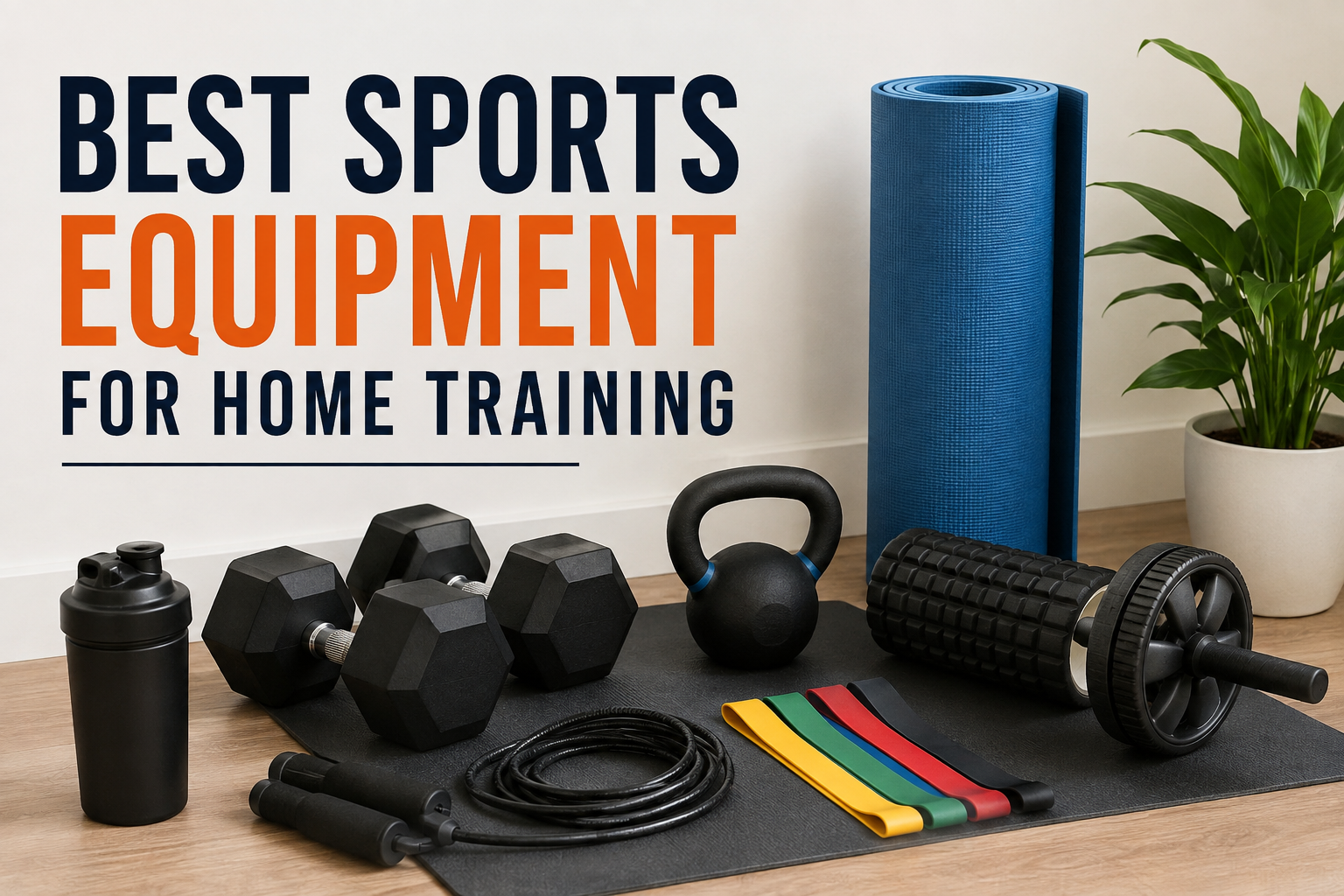
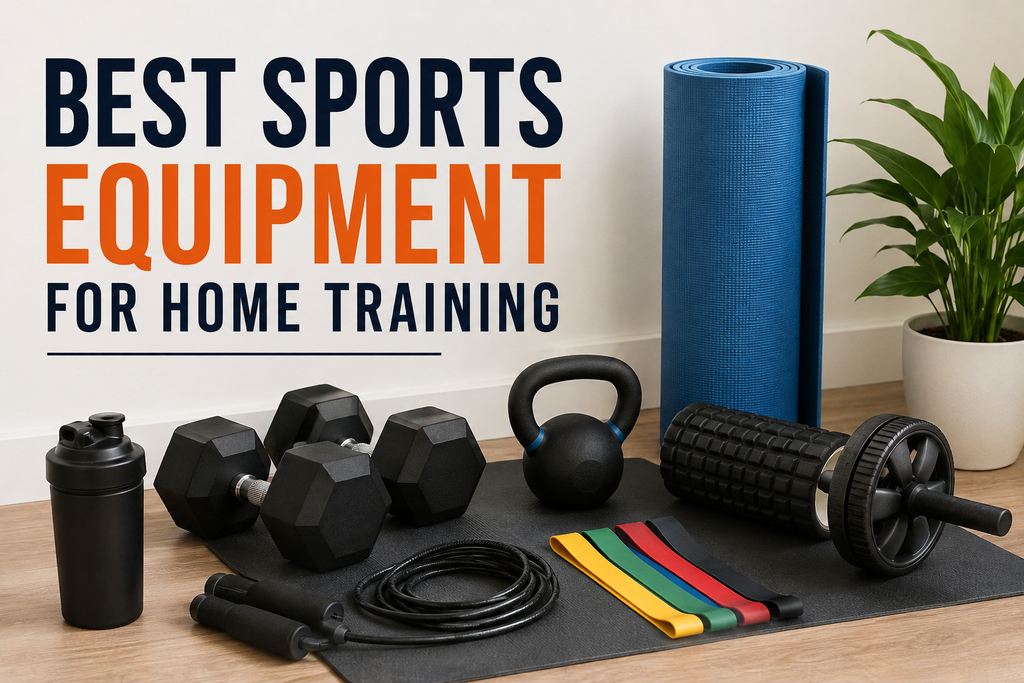
If I were building a home training setup from the beginning, I would start with an exercise mat, a pair of dumbbells, resistance bands, and a jump rope.
This combination can support strength training, cardio, mobility, and basic conditioning. After using these items for several weeks, I would decide whether additional equipment is actually necessary.
For example, someone interested in bodyweight training may benefit from a pull up bar. Someone focused on athletic performance may prefer an agility ladder or medicine ball.
The important thing is to build your equipment collection around your training goals instead of buying products simply because they look impressive.
Safety Tips for Home Workouts
Before starting any workout, check your training area. Remove objects that could cause you to trip or fall. Make sure equipment is in good condition and use it according to its intended purpose.
Start with a proper warmup, especially before intense exercise. Learn the correct technique for each movement and avoid increasing resistance too quickly.
If an exercise causes sharp or unusual pain, stop and reassess your technique or seek appropriate professional advice.
Good equipment can support your training, but it cannot replace proper form, consistency, rest, and a sensible workout plan.
Final Thoughts
The best sports equipment for home training is equipment that you will actually use. You do not need an expensive home gym to become stronger, fitter, and more active.
An exercise mat, dumbbells, resistance bands, jump rope, and kettlebell can provide a strong foundation for many people. As your fitness improves, you can add equipment that supports your specific goals.
From my point of view, consistency is more important than having a large collection of workout equipment. Start simple, learn the exercises properly, and gradually build your home training setup around the activities you enjoy.
With the right approach, home training can become a practical and enjoyable part of your everyday fitness routine.