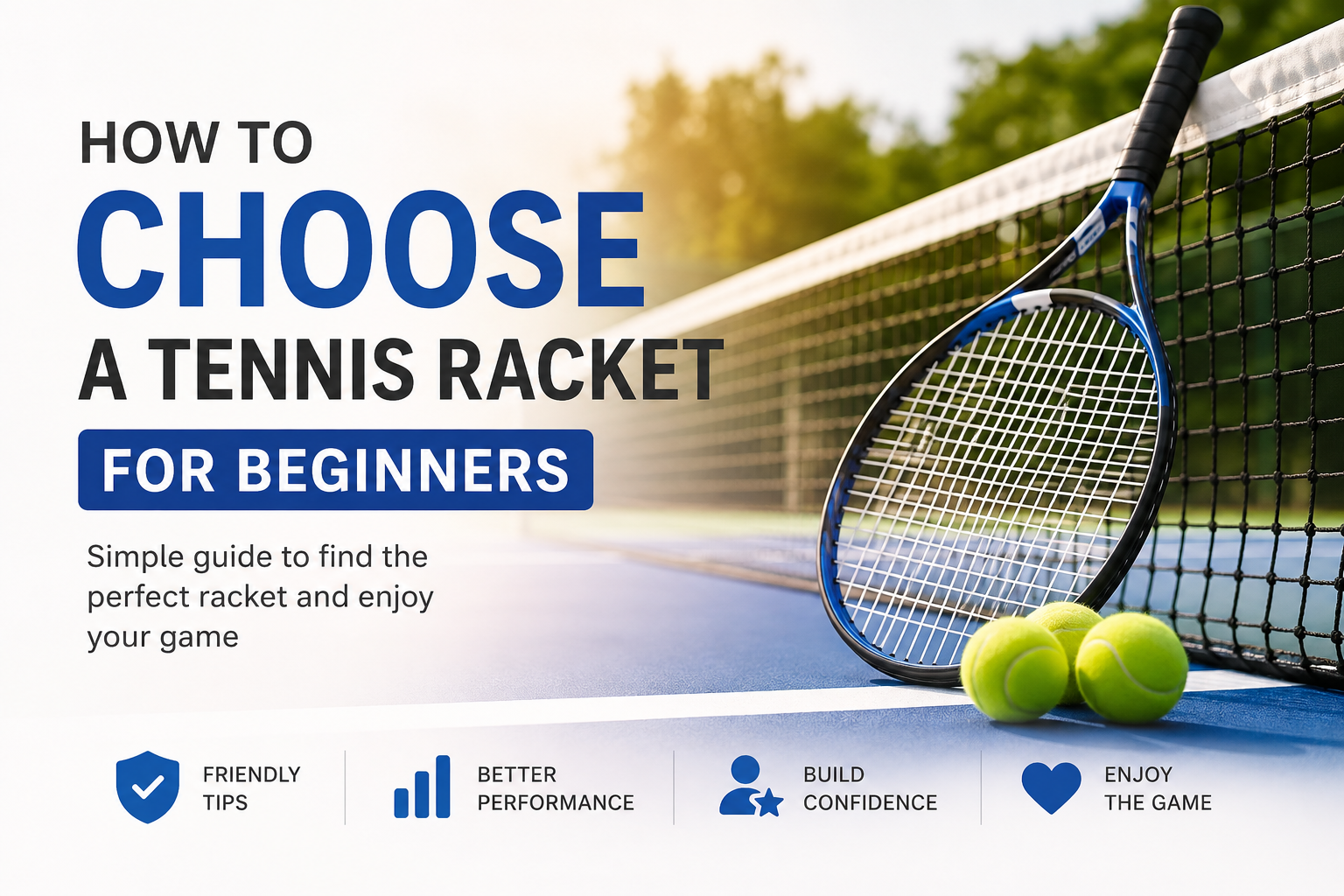
Choosing your first tennis racket can feel confusing, especially when you see so many different sizes, weights, shapes, and prices. When I first started learning about tennis equipment, I realized that the best racket is not necessarily the most expensive one. A good beginner tennis racket should feel comfortable in your hand, be easy to control, and help you enjoy learning the game.
In my opinion, beginners should focus on comfort and control rather than trying to buy professional equipment. The right racket can make it easier to learn proper technique, improve confidence, and enjoy every practice session. In this guide, I will explain how to choose a tennis racket for beginners and what features you should consider before making your purchase.
Why Choosing the Right Tennis Racket Matters
A tennis racket is one of the most important pieces of equipment you will use on the court. It affects how easily you can control the ball, how much power you can generate, and how comfortable you feel during a match.
For beginners, a racket that is too heavy can make learning difficult. You may become tired quickly and struggle to swing naturally. On the other hand, a racket that is too light may not provide enough stability when you hit the ball.
I believe the best beginner tennis racket should provide a balance between weight, power, control, and comfort. You do not need a highly specialized racket when you are still learning the basic strokes.
Consider the Racket Weight
Racket weight is one of the first things I recommend checking. Tennis rackets are available in different weights, and the right choice depends on your strength, age, playing experience, and comfort.
A lighter racket is usually easier to swing. This can be helpful for beginners who are still developing their technique. A slightly heavier racket can provide more stability and power, but it may require more strength and control.
If you are a complete beginner, I would generally suggest starting with a racket that feels manageable rather than choosing the heaviest option available. Hold the racket in your hand and make a few natural swings. If your arm feels comfortable and the racket does not feel difficult to control, that is a good sign.
Choose the Right Head Size
The racket head size is another important factor when choosing a tennis racket for beginners. A larger racket head provides a bigger sweet spot, which means you have a better chance of making a good contact with the ball.
This is particularly useful when you are learning because beginners do not always hit the center of the strings.
A larger head can also provide additional power. For someone who is still working on developing a consistent swing, this can make the game more enjoyable.
I would recommend looking at an oversized or mid plus racket head if you are new to tennis. You do not need to worry too much about professional specifications at this stage. Your main goal should be finding a racket that makes hitting the ball easier.
Pay Attention to Racket Balance
Racket balance describes how the weight is distributed throughout the racket. Some rackets have more weight toward the head, while others have more weight toward the handle.
A head heavy racket can provide additional power because more weight is located behind the ball. A head light racket can feel easier to maneuver and may provide better control at the net.
For beginners, I think a balanced racket is often a comfortable choice. It can give you a combination of power and maneuverability without making the racket feel difficult to handle.
The important thing is how the racket feels when you actually swing it. Specifications are useful, but personal comfort matters just as much.
Find the Correct Grip Size
Grip size is something beginners sometimes overlook, but I consider it very important. A racket grip that is too large or too small can make the racket uncomfortable to hold and may affect your technique.
Your hand should be able to hold the racket naturally without squeezing it too tightly. If the grip is too small, you may feel that you have to use extra effort to keep the racket stable. If it is too large, changing your grip can become uncomfortable.
If you are unsure about the correct grip size, visit a tennis shop and try several options. Holding different rackets can help you understand which size feels most natural.
Look for a Comfortable String Pattern
The string pattern also affects how a tennis racket performs. You will commonly see open and dense string patterns.
An open string pattern can help generate spin and may provide a softer feel. A dense string pattern can offer greater control and durability.
As a beginner, you probably do not need to make this decision too complicated. A racket with a comfortable string setup can be a good starting point while you learn the fundamentals.
I would focus more on finding a racket that feels comfortable and forgiving rather than trying to select an advanced string configuration.
Think About Your Playing Style
Even if you are a beginner, it is useful to think about the type of tennis you want to play.
Some players enjoy staying near the baseline and hitting powerful shots. Others prefer moving toward the net and playing with quick reactions. Some beginners simply want a comfortable racket for recreational games.
If you naturally prefer powerful baseline shots, a racket designed to provide easier power may suit you. If you are more interested in control and quick movement, a maneuverable racket may be a better choice.
Your playing style can change as you gain experience, so do not worry about finding a perfect racket that you will use forever.
Consider Your Age and Strength
Age and physical strength should also influence your decision. Children and younger beginners usually need smaller and lighter rackets that match their height and strength.
Adults can generally choose from a wider range of standard rackets. However, that does not mean every adult should choose a heavy model.
I believe comfort should always come first. If you cannot swing the racket naturally for an extended period, it is probably not the right choice for you.
Do Not Buy Only Because of the Brand
There are many famous tennis racket brands, and it can be tempting to choose a racket simply because you recognize the name. While established brands can offer excellent equipment, the brand name alone does not guarantee that a racket is right for you.
A beginner should compare the racket’s weight, head size, grip, balance, comfort, and price.
In my view, it is better to buy an affordable racket that suits your needs than an expensive professional racket that you cannot control properly.
Set a Realistic Budget
Tennis rackets are available at many different prices. You can find affordable beginner models as well as premium rackets designed for experienced players.
When buying your first racket, I recommend setting a realistic budget before you start shopping. Remember that tennis equipment does not end with the racket. You may also need tennis balls, shoes, grips, a racket bag, and other accessories.
There is no need to spend a huge amount of money just because you are starting a new sport. A good quality beginner tennis racket can provide everything you need while you learn.
Try Before You Buy
If possible, I strongly recommend trying a racket before buying it. Even two rackets with similar specifications can feel completely different in your hand.
Take a few swings and pay attention to the weight, grip, balance, and overall comfort. If a tennis club or local sports store allows you to test rackets, take advantage of that opportunity.
You can also ask an experienced tennis player or coach for an opinion. Someone who understands your playing level can often help you avoid a poor choice.
Avoid Choosing a Professional Racket Too Early
Professional tennis rackets may look impressive, but they are not always suitable for beginners. Some advanced rackets are designed for players who already have strong technique, fast swings, and good physical conditioning.
A beginner needs forgiveness and easy handling. If your racket requires a high level of skill just to produce comfortable shots, it may slow down your progress.
I think beginners should first learn the fundamentals and develop consistency. You can always move to a more advanced racket later when your skills improve.
Check the Racket’s Comfort
Comfort is one of the most important things to consider when choosing a tennis racket. Tennis involves repeated swings, so your equipment should feel natural and manageable.
When testing a racket, pay attention to how your arm and hand feel. You should not have to grip the handle excessively hard just to control the racket.
If possible, practice with the racket for more than a few minutes. A racket that feels comfortable during a short test may feel different after a longer session.
Common Mistakes Beginners Should Avoid
One common mistake is buying a racket simply because it looks attractive. Appearance is nice, but performance and comfort should come first.
Another mistake is choosing a racket that is too heavy. Beginners sometimes assume that more weight automatically means better performance. In reality, a racket that you cannot swing comfortably can make learning more difficult.
Some players also spend too much money on their first racket. Expensive equipment will not automatically improve your technique.
Finally, do not ignore grip size. A comfortable grip can make a noticeable difference in how confidently you hold and swing the racket.
Final Thoughts
Learning how to choose a tennis racket for beginners does not have to be complicated. In my opinion, the best approach is to focus on the basics: weight, head size, balance, grip size, comfort, and price.
A good beginner tennis racket should be easy to control and comfortable enough to use during regular practice. You do not need the most expensive model or the same racket used by professional players.
Take your time, compare a few options, and try different rackets if you can. As your skills improve, your preferences will become clearer. The racket that feels right today may not be the same one you want several years from now, and that is completely normal.
Most importantly, remember that tennis is supposed to be enjoyable. The right racket should help you feel comfortable, confident, and excited to get back on the court. If you choose equipment that matches your ability and physical comfort, you will have a much better foundation for improving your tennis game.