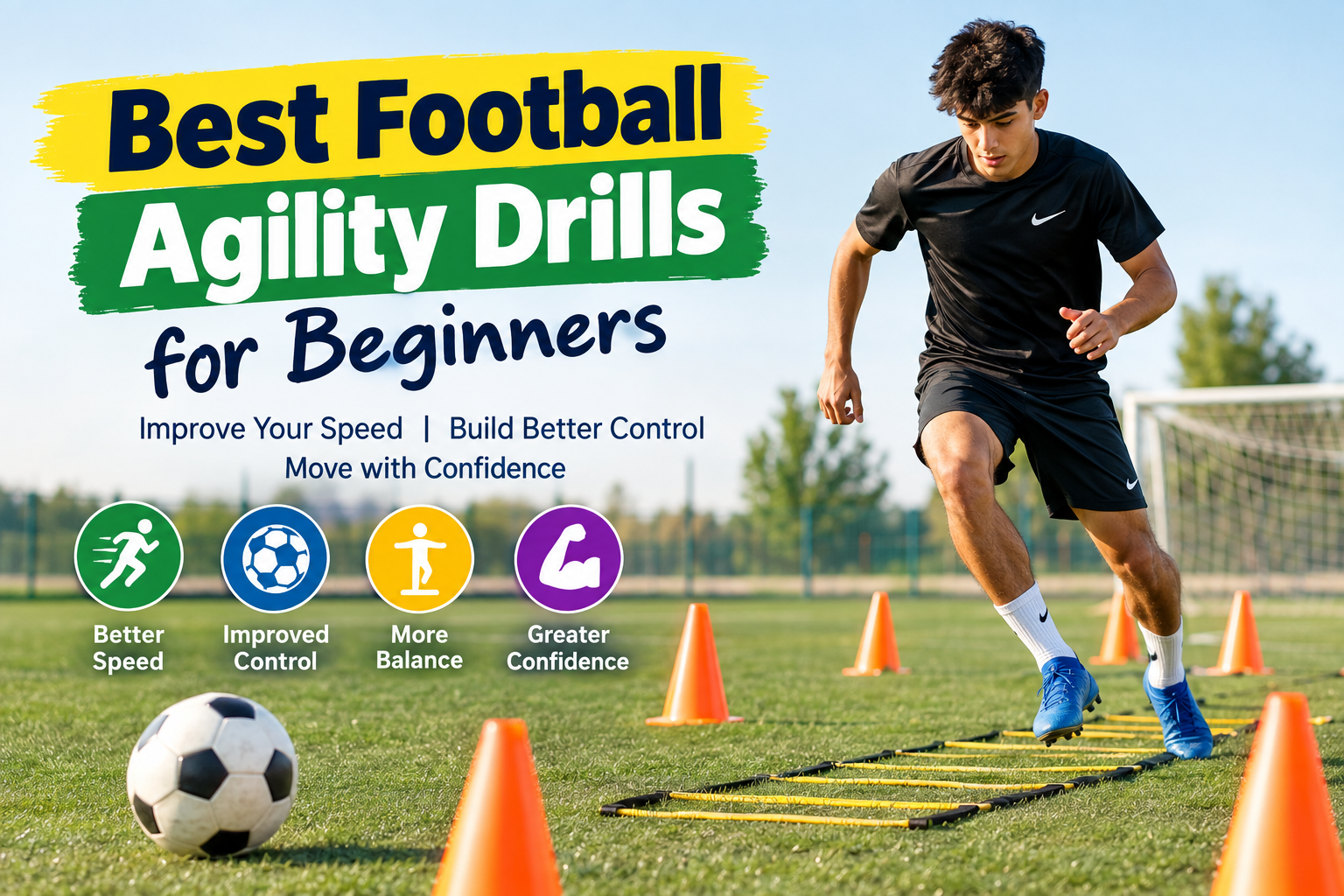
Football is a game that requires more than just good passing and shooting. In my experience, one of the most important skills a beginner can develop is agility. Agility helps a player move quickly, change direction, react to opponents, and stay balanced while controlling the ball.
When I think about football agility, I do not only think about running fast. A player can be quick in a straight line but still struggle when they need to turn, stop, accelerate, or move sideways. This is why football agility drills are so useful for beginners.
The good thing is that you do not need expensive equipment or a professional training ground to improve your agility. With a few cones, an agility ladder, or even simple objects that are safe to use as markers, you can perform effective football agility exercises at home or on a local field.
In this article, I will share some of the best football agility drills for beginners and explain how each drill can help improve movement, balance, coordination, and quickness.
Why Football Agility Is Important
Agility is important because football is full of unexpected movements. During a match, you may need to move around a defender, chase an opponent, receive a pass while changing direction, or quickly move into an open position.
Good agility allows you to make these movements with better control.
For beginners, agility training can also improve body coordination. When you regularly practice changing direction and controlling your body, your movements can become smoother and more confident.
I also believe that agility training should not be about rushing through every exercise. Good technique is more important than speed when you are learning.
1. Agility Ladder Quick Steps
The agility ladder is one of the most popular tools for football agility training. If you have an agility ladder, place it flat on the ground and start at one end.
Move through each section using quick steps. Try to keep your feet light and your body slightly forward.
At first, focus on putting one foot into each section. Once you become comfortable, you can increase your speed.
This drill helps improve footwork, coordination, balance, and quick movement.
If you do not have an agility ladder, you can create imaginary squares on the ground or use flat markers. The goal is to practice controlled foot movement rather than simply moving as fast as possible.
2. Cone Zigzag Drill
The cone zigzag drill is another simple football agility exercise that I recommend for beginners.
Place several cones in a straight line with enough space between them. Start at one end and run around each cone in a zigzag pattern.
Keep your knees slightly bent and try to stay balanced when changing direction.
One mistake beginners often make is taking very large steps around the cones. Smaller controlled steps usually make it easier to change direction quickly.
As your technique improves, you can gradually increase your speed.
This drill is useful because football players frequently need to change direction while moving around opponents.
3. Lateral Shuffle Drill
Lateral movement is very important in football, especially when defending.
For this drill, place two cones several steps apart. Start beside one cone and shuffle sideways toward the other cone. When you reach it, immediately shuffle back.
Try to keep your body low and avoid crossing your feet.
The lateral shuffle can improve side to side movement, balance, and defensive footwork.
I recommend starting slowly because beginners sometimes focus too much on speed and lose their body position.
Once the movement becomes comfortable, you can increase the pace.
4. Forward and Backward Sprint Drill
This is a simple drill that can be performed almost anywhere.
Place two cones several meters apart. Start at one cone, sprint forward to the second cone, then turn and move backward toward the starting position.
When moving backward, take controlled steps and keep your head up.
This drill helps develop acceleration, deceleration, coordination, and body control.
It can also teach you how to transition quickly between forward and backward movement.
For beginners, I suggest using a comfortable distance rather than making the drill unnecessarily difficult.
5. T Drill
The T drill is one of my favorite football agility exercises because it combines forward movement, sideways movement, and quick changes of direction.
Place four cones in a T shape. Start at the bottom of the T and sprint toward the center cone. From there, move sideways to one side, then across to the other side, return to the center, and finish by moving backward to the starting point.
This drill can challenge your ability to accelerate, stop, turn, and move laterally.
Beginners should concentrate on correct movement before trying to complete the drill quickly.
6. Box Agility Drill
For the box agility drill, place four cones in a square.
Start at one corner and move forward to the next cone. Then move sideways, backward, and sideways again until you return to your starting position.
The purpose is to practice movement in different directions.
This is particularly useful for beginners because football rarely requires you to run only forward. Players need to move in multiple directions depending on where the ball and other players are located.
Try to maintain good posture throughout the exercise.
7. Five Cone Reaction Drill
Agility is not only about planned movement. Reaction is also important.
Place five cones in different positions around a small training area. Have a training partner call out a cone, and quickly move toward that cone.
If you train alone, you can create a simple sequence and change it regularly so that you do not simply memorize the movement.
This drill helps develop reaction speed and decision making.
In a real football match, you often have to react to another player’s movement instead of knowing exactly where you will go next.
8. In and Out Cone Drill
Place several cones in a straight line. Move your feet inside and outside the cone area while progressing forward.
Keep your steps short and controlled.
This exercise is useful for improving foot coordination and quick changes in direction.
It may feel easy at first, but increasing the speed while maintaining control can make it much more challenging.
I recommend focusing on clean footwork instead of trying to move at maximum speed immediately.
9. Single Leg Balance Drill
Agility is closely connected to balance.
Stand on one leg for around 20 to 30 seconds. Keep your body upright and your eyes focused ahead. Then switch legs.
Once you become comfortable, you can make the exercise more challenging by gently moving your free leg or catching a football while maintaining balance.
This simple exercise can help improve stability.
Good balance is especially useful when changing direction, challenging for the ball, or preparing to make a pass after a quick movement.
10. Sprint and Stop Drill
Acceleration is useful, but being able to stop under control is equally important.
Place two cones several meters apart. Sprint toward the second cone and slow down before reaching it. Stop under control and then return to the starting position.
This drill teaches your body to control momentum.
Beginners should avoid suddenly stopping at maximum speed. Gradually reduce your speed and focus on maintaining balance.
With regular practice, you can become more comfortable with acceleration and deceleration.
How Often Should Beginners Practice Agility?
You do not need to perform agility drills every day.
For beginners, two or three agility sessions per week can be enough when combined with football practice, rest, and other physical activities.
A short session of around 15 to 25 minutes can be useful.
The quality of your movements matters more than the length of the workout. If your technique becomes poor because you are tired, it is better to rest and continue another time.
Warm Up Before Agility Training
I always recommend warming up before performing fast football agility drills.
Start with a few minutes of light jogging. Then perform controlled movements such as leg swings, easy side steps, and gentle changes of direction.
A proper warm up helps prepare your body for more demanding movement.
Do not immediately begin with maximum speed. Give your body time to become comfortable with the movements.
Common Mistakes Beginners Should Avoid
One common mistake is trying to perform every drill as quickly as possible.
Speed is useful, but poor technique can reduce the value of the exercise. Learn the movement first and increase your speed gradually.
Another mistake is using too many drills in one session. You do not need ten different exercises every time you train. Choosing three or four drills and performing them properly can be more productive.
Some beginners also forget about recovery. Your body needs time to recover after demanding training sessions.
Finally, avoid comparing your speed with another player. Everyone develops at a different pace. Focus on improving your own movement and consistency.
Simple Beginner Football Agility Workout
If you are just starting, you can use a simple routine like this:
Start with five minutes of light jogging and movement.
Perform agility ladder quick steps for three rounds.
Perform the cone zigzag drill for three rounds.
Perform lateral shuffles for three rounds.
Finish with the sprint and stop drill for three rounds.
Rest between rounds and focus on maintaining good technique.
As your fitness and coordination improve, you can gradually increase the intensity.
Can Agility Training Improve Football Performance?
Agility training can help develop physical qualities that are useful in football, including quick movement, coordination, balance, acceleration, and changes of direction.
However, agility drills should not replace actual football practice.
A player also needs to practice passing, shooting, dribbling, ball control, positioning, and decision making.
I believe the best approach is to combine football skills with physical training. For example, after completing an agility drill, you can practice dribbling through cones or receiving a pass and changing direction.
This makes your training more closely connected to situations that happen during a match.
Final Thoughts
In my view, the best football agility drills for beginners are the ones that are simple enough to perform correctly and challenging enough to improve movement over time.
Agility ladder exercises, cone zigzag drills, lateral shuffles, T drills, box drills, reaction exercises, and sprint and stop drills can all be included in a beginner football training routine.
You do not need complicated equipment to get started. A few cones and a small training area can be enough.
The most important thing is consistency. Practice your movements regularly, focus on balance and technique, and increase your speed gradually.
With patience and regular football agility training, beginners can develop better footwork, quicker changes of direction, improved coordination, and greater confidence on the football field.