
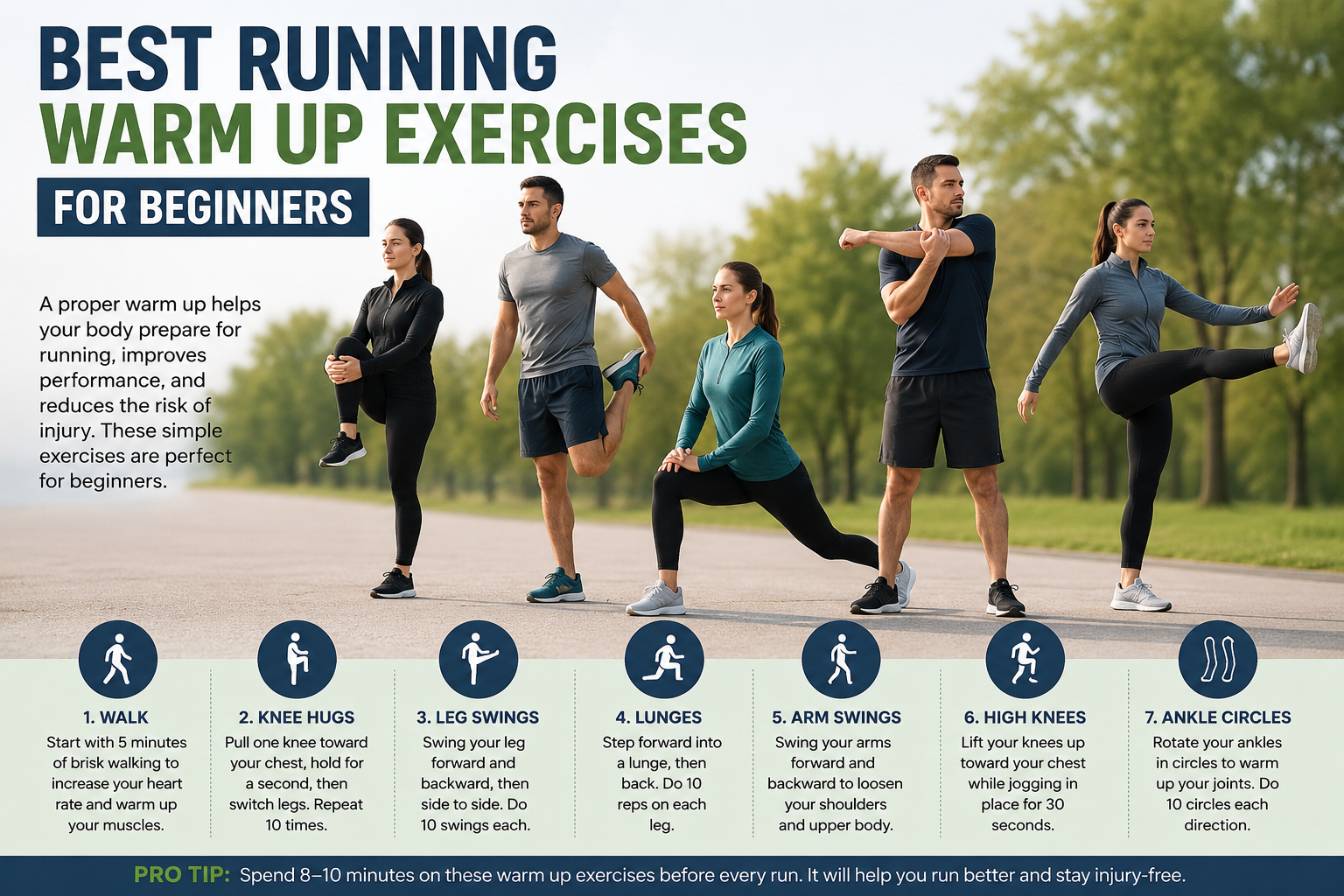
Starting a running routine can be exciting, especially when you want to improve your fitness, build stamina, or simply become more active. In my experience, one thing beginners often overlook is the importance of warming up before running. A good warm up does not need to be complicated or take a lot of time. Even a few simple movements can help prepare your body for the activity ahead.
The best running warm up exercises for beginners are simple, controlled, and focused on preparing the muscles and joints for movement. A proper warm up can gradually increase your heart rate, improve mobility, and help your body transition from rest to running.
In this article, I will share some of the most useful running warm up exercises for beginners and explain how I would use them before a running session.
Why Is a Warm Up Important Before Running?
Before starting any exercise, your body needs some time to adjust. If you go directly from sitting or standing still into fast running, your muscles may not be properly prepared for the sudden increase in activity.
A warm up gradually increases your body temperature and gets your muscles moving. It can also help improve your range of motion and make running feel more comfortable.
For beginners, a warm up is especially useful because the body is still adapting to the demands of running. I believe spending around 8 to 10 minutes warming up is a simple habit that can make a running routine feel much better.
A warm up is not about exhausting yourself. The goal is to prepare your body without using too much energy before the actual run.
1. Brisk Walking
One of the easiest running warm up exercises is brisk walking. I recommend starting with a few minutes of comfortable walking before moving into faster activity.
Begin at a normal walking pace and gradually increase your speed. Keep your shoulders relaxed and allow your arms to move naturally.
Try brisk walking for about 3 to 5 minutes. This gives your body time to increase its heart rate and warm up the muscles in your legs.
The great thing about brisk walking is that almost every beginner can do it. You do not need special equipment, and you can perform it on the same route where you plan to run.
2. Knee Hugs
Knee hugs are a simple dynamic warm up exercise that can help prepare your hips and legs for running.
Stand upright and slowly bring one knee toward your chest. Hold it briefly while maintaining your balance, then lower the leg and repeat with the other side.
I usually recommend around 8 to 10 repetitions on each side. Try to keep the movement controlled rather than pulling aggressively on your knee.
This exercise can help you focus on hip movement while gently preparing your legs for running.
3. Leg Swings
Leg swings are another useful dynamic movement for runners. They can help prepare your hips and legs for the repeated movement involved in running.
Stand beside a wall or another stable surface if you need support. Swing one leg gently forward and backward while keeping your upper body relatively stable.
Start with small movements and gradually increase the range as your body becomes more comfortable.
Perform about 10 swings on each leg. You can also perform controlled side to side leg swings if they feel comfortable.
The key is to avoid forcing the movement. A warm up should make your body feel prepared, not strained.
4. Walking Lunges
Walking lunges can be a useful part of a beginner running warm up because they involve several muscles used during running.
Start by standing upright. Take a comfortable step forward and lower your body into a lunge. Keep your movement controlled and then push through the front foot to return to a standing position.
Continue with the opposite leg.
You do not need to perform deep lunges. For beginners, comfortable and controlled movements are more important than trying to achieve a large range of motion.
Around 6 to 10 lunges on each side can be enough for a basic warm up.
5. Arm Swings
Running is not only about your legs. Your arms also play an important role in maintaining rhythm and balance.
Arm swings are very easy to perform. Stand comfortably and swing your arms forward and backward in a relaxed manner.
Avoid making the movement too aggressive. Your shoulders should stay relaxed.
I like including arm movements in a running warm up because they help prepare the upper body while also encouraging a natural running posture.
Try arm swings for about 20 to 30 seconds.
6. High Knees
High knees can help raise your heart rate and prepare your legs for running. However, beginners do not need to perform them at maximum speed.
Stand upright and slowly lift one knee toward your waist while keeping the opposite foot on the ground. Alternate between both legs.
Once you become comfortable, you can perform the movement at a slightly faster pace.
For a beginner warm up, around 20 to 30 seconds is usually enough. Focus on maintaining good posture and controlled breathing.
If high knees feel uncomfortable, simply perform marching high knees instead. The goal is to warm up, not to turn the warm up into a workout.
7. Ankle Circles
Your ankles absorb a lot of movement while you run, so I think it is useful to include a simple ankle mobility exercise before running.
Stand while holding onto something stable if necessary. Lift one foot slightly from the ground and slowly rotate the ankle in circles.
Perform around 8 to 10 circles in one direction and then change direction. Repeat on the other ankle.
Keep the movement gentle. There is no need to force your ankle into a large circle.
This exercise can help you pay attention to your ankles before starting your run.
8. Easy Jogging
After completing your basic warm up exercises, an easy jog can be a good transition into running.
Start at a very comfortable pace. You should feel like you could easily maintain a conversation.
Jog for about 2 to 3 minutes before gradually moving into your normal running pace.
I personally think this is one of the best ways for beginners to finish a warm up because it allows the body to experience running movement before the actual workout begins.
A Simple 10 Minute Running Warm Up Routine
If you are a beginner and do not want to spend too much time deciding which exercises to do, you can follow a simple routine.
Start with 3 minutes of brisk walking. Then perform knee hugs for about 30 seconds, followed by leg swings for about 30 seconds on each side.
Next, perform walking lunges for around 1 minute. Follow them with relaxed arm swings for 30 seconds.
After that, perform easy high knees or marching high knees for around 30 seconds. Finish with ankle circles and 2 minutes of very easy jogging.
The exact timing does not need to be perfect. What matters most is gradually increasing your activity level instead of suddenly starting at full running speed.
Should Beginners Stretch Before Running?
This is a common question among new runners. I prefer dynamic movements before running rather than spending a long time holding static stretches.
Dynamic movements involve controlled motion, such as leg swings, walking lunges, knee hugs, and marching. They allow your body to move through different positions while preparing for activity.
Long static stretches may be better suited to another part of your fitness routine, depending on your goals and individual needs.
For a running warm up, I would focus mainly on gentle movement and gradually increasing intensity.
Common Warm Up Mistakes Beginners Should Avoid
One mistake is skipping the warm up because you are in a hurry. Spending even 5 to 10 minutes preparing your body is better than immediately starting a hard run.
Another mistake is making the warm up too intense. If you are already tired before the run begins, you have probably done too much.
Some beginners also rush through exercises. I believe controlled movements are more useful than simply trying to complete them as quickly as possible.
Another mistake is ignoring discomfort. A normal warm up should feel comfortable. If an exercise causes sharp or unusual pain, stop the movement rather than trying to push through it.
How Long Should a Running Warm Up Take?
For most beginners, around 8 to 10 minutes is a practical starting point. If the weather is cold or you are preparing for a faster workout, you may want to spend more time gradually increasing your activity.
For an easy short run, a brief warm up may be enough. For intervals, hill running, or a faster training session, I would spend more time preparing the body.
The important thing is to listen to how your body feels.
Final Thoughts
A running warm up does not have to be complicated. In my opinion, beginners should focus on simple movements that gradually prepare the entire body for running.
Brisk walking, knee hugs, leg swings, walking lunges, arm swings, high knees, ankle circles, and easy jogging can create a practical warm up routine without requiring any equipment.
The biggest benefit is consistency. Once warming up becomes part of your running habit, it becomes much easier to remember.
If you are just starting your running journey, take your time and do not worry about running fast. Build your routine gradually, pay attention to your body, and make warming up a regular part of every session.
A few extra minutes before your run can help you feel more prepared, confident, and comfortable when you begin. For beginners, that simple preparation can make running feel much more enjoyable.
SEO Keywords: best running warm up exercises for beginners, running warm up exercises, warm up before running, beginner running warm up, dynamic warm up for runners, exercises before running, running exercises for beginners
